Thanksgiving 2025
Thanksgiving Day Homily.
Dear brothers and sisters in Christ,
Happy Thanksgiving to you all! I’ll begin with joke that is appropriate for our celebration:
Q: If April showers bring May flowers, what do May flowers bring?
A: Pilgrims, of course!
Our readings are appropriate for today’s celebration. We have just heard from our Gospel about the man being healed by Jesus and returning to give him thanks. Jesus seems surprised that only this one of the ten returned to give thanks to God. Even though, there seems to be ingratitude on the part of the other nine, Jesus, appreciates the gratitude of this healed leper who is a foreigner. This Gospel then gives us an important teaching on gratitude... a wonderful example of giving thanks.
Today’s holiday commemorates a harvest festival celebrated by the Pilgrims in 1621. The story goes that the English colonists, the pilgrims, landed a Plymouth and had built a settlement there. They had gone out hunting for food preparing for a festival. Soon about 90 of the Wampanoag people (who were the Native Americans) showed up at their settlement’s gate, they contributed their own food for the feast. And they all feasted and partied speaking to each other in broken English and Wampanoag. There, they made a treaty between the two groups. So the thanksgiving tradition was born.
Over time the yearly celebration became more popular over time, especially in the Northern states; it was made a national holiday by President Abraham Lincoln on October 3, 1863, and we continue to hold this tradition in the US on the fourth Thursday in November. From that tradition developed our own tradition of family gathering around the table and eating Turkey – a bird that is native to the United States.1
In his proclamation of the Holiday, Abraham Lincoln recognized terrible consequences of war, and at the same time recognized that all our blessings come from God’s almighty hand. At end of the proclamation, he wrote:
I do therefore invite my fellow citizens in every part of the United States, and also those who are at sea and those who are sojourning in foreign lands, to set apart and observe the last Thursday of November next, as a day of Thanksgiving and Praise to our beneficent Father who dwelleth in the Heavens. And I recommend to them that while offering up the ascriptions justly due to Him for such singular deliverances and blessings, they do also, with humble penitence for our national perverseness and disobedience, commend to His tender care all those who have become widows, orphans, mourners or sufferers in the lamentable civil strife in which we are unavoidably engaged, and fervently implore the interposition of the Almighty Hand to heal the wounds of the nation and to restore it as soon as may be consistent with the Divine purposes to the full enjoyment of peace, harmony, tranquility and Union.
Thanksgiving is a wonderful holiday, and an important one. So we see that it does have some religious overtones and, I’m glad that we even have a special votive Mass in the Church for us here in the United States, because giving thanks is so important in our Christian life.
I remember that when I was studying in Rome, I was at the North American College, which was a little piece of America there in Rome, we would celebrate Thanksgiving. It was a big deal for us there. We all missed home and it was a way for us to celebrate the blessings we have received. So we had the usual meal: Turkey, potatoes, cranberry sauce, and of course pasta – because in Rome every meal comes with pasta. It was an important celebration for us, so much so that we would be excused from classes on that day (because obviously the holiday didn’t have any significance to the Italians in Rome), but for us it provided some connection with home … and an opportunity for us to give thanks.
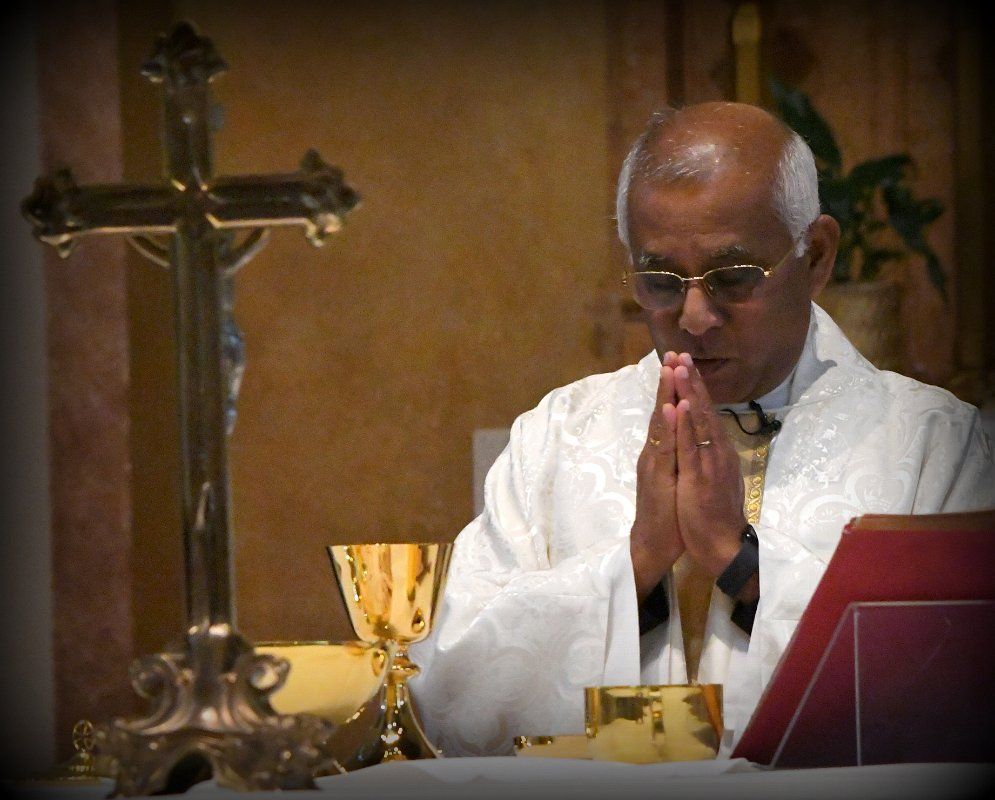
The Mass we celebrate is about thanksgiving. Eucharist is derived from the Greek word that means thanksgiving. And we have much to be thankful for.
If we watch the news and the media, it will often highlight what is wrong with the world. There is a disturbing trend in our culture today to demonize a holiday such as this because if there is any mention of the Native Americans, we are supposed to recognize how they were oppressed and their land has been taken away; and we are not allowed to celebrate the blessing we have. No, no, it is OK to recognize there are many things that are right with the world.
President Lincoln recognized that a country embroiled in war needed a day of Thanksgiving; yes, this a recognition of the need for humble penitence, but at the same time giving thanks to God, and asking His hand to be upon our nation to heal wounds of the nation.
We do have much to be thankful for. We have our families, we have the freedom of speech. We have the freedom to practice our religion. We have the freedom to gather together and worship our God. We have a God who loved us so much that “He sent his only Son and became a man.” And we have a God who became man for us and instituted for us a meal… which we might say is the original thanksgiving meal, not with turkey and stuffing, not with cranberry sauce and gravy, but, instead, He gave us his very Body and Blood. And he promised at that meal that if we consume his body and blood, we will have life in us… divine life. And because of this He remains with us until the end of the age. So, indeed, we have much to be thankful for.
Our readings today are all about thanksgiving. Our first reading gives praise to God for the wondrous deed he has done on earth, especially giving thanks for the gift of human life. Our psalm is a hymn of praise and thanksgiving. In our Gospel today, when our Lord heals the 10 lepers, he was surprised that it only the foreigner who had come back to thank him.
We see, then, the need to have an attitude of Gratitude. It is so important to cultivate our Thanks to God. And it is a skill that we need to learn sometimes, it doesn’t always come naturally. Our prayer should always begin with thanksgiving.
There are basically four kinds of prayer. These types of prayer respond basically to what God has already done for us and what we would like God to do for us. The first type of prayer is praise and thanksgiving; the second is petition and intercession. The first type is a response out of our abundance. And the second is a response to our weakness and poverty.
If you have trouble with your prayer of praise and thanksgiving, you might just look at the beginnings of most of St. Paul’s letters. They usually begin with praise and thanksgiving.
So I will conclude echoing the words of St. Paul in our 2nd reading today: “I give thanks to my God always on your account for the grace of God bestowed on you in Christ Jesus, that in him you are not lacking in any spiritual gift as you wait for the revelation of our Lord Jesus Christ. He will keep you firm to the end, irreproachable on the day of our Lord Jesus Christ. God is faithful, and by him you were called to fellowship with his Son, Jesus Christ our Lord.”
We must be a people of thanksgiving, so let us remember as we gather with our families and friends today, to pray and thank God in our prayers this day; and if you have trouble thinking of something; remember that you have been here today in this house of worship; at the original meal of Thanksgiving, Eucharist, where heaven and earth of united in praise and thanksgiving in worship before God’s holy throne.
- Fr. Ron Nelson